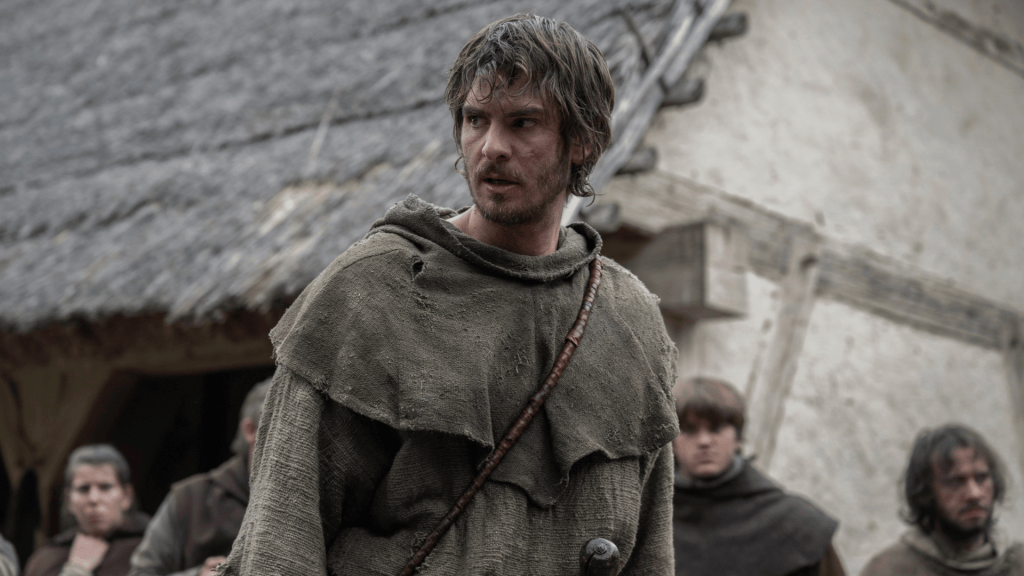
The fact that no one could figure out how to market The Uprising in the USA is no surprise. History in US schools starts with the founding of the country, which wasn’t that long ago, really. An American knowing about something that happened in the 14th century besides the plague is unusual, and most wouldn’t even know what century the plague happened in. So to sell The Uprising, they plugged in some strange reference to Robin Hood, quickly pulled that back when it further confused everyone, and finally just let the movie stand on its own vagueness. The title could reference any number of historical events, which is kind of a good thing, because if people Google it they’d realize they’re in for a massive bummer.
The film is about the Peasants’ Revolt, where rural Britons who had lived through the plague, wars, and the confines of serfdom finally snapped after being charged a series of increasing taxes. If that sounds like a dreary series of events, keep in mind that the 14th century is often cited as the worst century to be alive. The people who revolted certainly knew their lives weren’t great, but considering they took a chance and tried to make their lives better, they clearly didn’t know the depths of how screwed they were.
The Uprising gives us a fictional everyman to follow: Andrew Garfield’s Ploughman. In the opening scenes, we learn that his family died and his farm is on the brink of failing. When he’s called into town for another tax collection and sees the government’s men brutalizing people to get their money, he snaps. He drives off the tax collector and kills one of the soldiers who try to tame him. The rest of his community rallies around him, and so does the audience. I mean, he’s been designed to be the most sympathetic guy you can imagine, and Garfield is excellent at playing earnest goodness. The Ploughman is a good man, while the tax collector and the government who sent him are bad. The movie isn’t interested in anything more complicated than that.
Which is too bad, because it’s too much of a simplification to make the events understandable, especially for those who are unaware of the history. There are key events the movie has to retain that betray the distance the non-ruling classes have come in the last 600+ years, and the film glosses over how bizarre they play today. When Ploughman and his fellow rebels begin upending society, they go after the nobility who keep them under serfdom and monasteries that hoard wealth, but they fervently stay behind their king. To modern eyes, this is bizarre, especially since the king at the time was a sniveling 14-year-old boy.
Instead of exploring the mental and logistical blocks that lead to this, writer/director Paul Greengrass is more interested in drawing parallels to today’s increasing class disparities and the labor rights movements that might reverse the trend. This leads to the everything, but especially the characters you follow, being whittled down to their most basic narrative functions. The Ploughman gives you the movie’s heart, and the real-life figures of the rousing priest John Ball (Jamie Bell) and former military man Wat Tyler (Cosmo Jarvis) give it its political bent. For good measure, it tacks on Thomasin McKenzie’s Alyce, whose presence nods to the revolt’s prominent female leaders without taking away from the movie’s manly-men vibes.
Greengrass fills in the space with a lot of action, all filmed in his usual shaky cam style. The sequences play well in the moment, getting the audience riled up and somewhere near the thrilling headspace these people must’ve felt as they marched to London. They were truly upending society and claiming rights we take for granted today, and reminding people of these fights can stir up hope for even more. But playing up the action is an odd route to take for this uprising. Make no mistake, there was violence, but it was also marked by a surprising amount of restraint. They burned paperwork and destroyed wealth, but they had strict rules about stealing and unnecessary bloodshed. For a long time, they remained focused on their efforts to tear down the old social structure. Eventually it fell apart, of course, and innocents were killed. But if we’re trying to hold this up as a pillar of civil rights battles, it’s odd to de-emphasis just how focused it was for a long time.
And that’s where The Uprising ultimately lands, as a slightly vague, misguided take on a historical oddity which deserves a more clear-eyed (and steadier) examination.
Release: now in theaters
Director: Paul Greengrass
Writer: Paul Greengrass
Cast: Andrew Garfield, Jamie Bell, Stephen Dillane, Tom Hollander, Cosmo Jarvis, Thomasin McKenzie, Jonny Lee Miller


Leave a Reply