Scientists usually get a bad rap in film. They face off against our most powerful superheroes, create artificial intelligence that overthrows humanity, or, more mundanely, fret over their work on the atomic bomb. The occasional positive takes are usually about science’s past successes. What it may achieve in the future is rarely imagined with hope.
Andy Weir, who wrote the book of the same name on which Project Hail Mary is based, has now pushed the industry to do it twice. The Martian, which saw the scientific community rally around a stranded Matt Damon to help him grow potatoes on Mars, wasn’t accurate just because of its well-researched details; it was also honest about science’s messiness, which stumbles as it pushes towards some of humanity’s greatest achievements. Weir imagines a similar story in Project Hail Mary, which follows an unlikely astronaut as he tries to save the world.
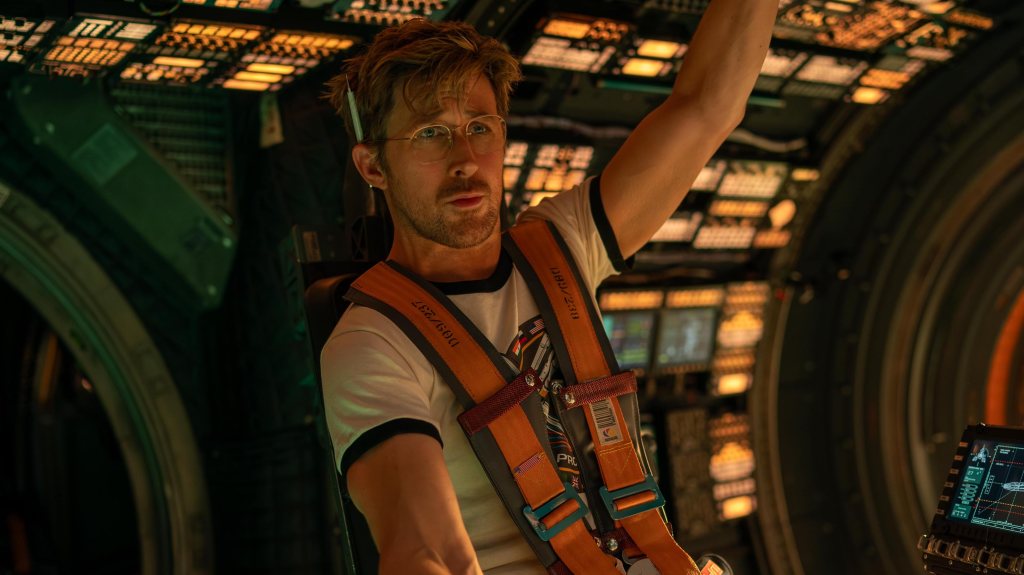
In this imagined near future, there’s a microorganism in space absorbing the sun’s energy, which will catastrophically cool down the planet. The microorganism is everywhere except around one faraway star, so a scientist is sent to the star to find out why. Cool mystery, but you can’t make a movie out of people staring into microscopes. What makes Project Hail Mary into a compelling story is the man who must do all this work: Ryan Gosling’s Ryland Grace.
We meet him in his middle school science class, where he leads with the bravado of a teacher who knows he’s good. He’s only here, however, because his career was derailed by his controversial research and abrasive inability to back down. The head of the world’s effort to save the planet, Eva (Sandra Hüller), has to strong-arm him to help. By the time he’s in space, though, his memory is wiped by the travel-necessitated coma, and he becomes a more compliant worker. His roguish nature is further broken down by the discovery of a lonely alien, and the two team up to solve their light-hungry microorganism problem.
Deep breath. The plot is long and complicated, the details being immensely important when telling a highly scientific story. But Project Hail Mary uses details for comedy and character building along with methodical problem-solving. One of the best examples is when Grace first encounters the alien. He’s understandably terrified to discover extraterrestrial life, exacerbating his fumbling as the two try to communicate. The dance between the two ships is comedy gold, as is Grace’s slow realization that he is the less intelligent life form. The unexpected contact evolves into wonder at this completely novel way of life, then annoyance as the two friends live more closely than any two creatures should.
This mundanity is the delightful perspective Weir has brought to both The Martian and Project Hail Mary. No matter how many extraordinary things occur, his characters spend as much time futzing about the things that have always and will always annoy us. You can only remain in a state of wonder for so long, even if it’s caused by something as mindblowing as an alien. Eventually, the little guy’s cultural differences and personal flaws will drive you up the wall.
Much of science fiction tries to load its story with too much of one thing, be it wonder, suspense, or mystery. Weir’s stories are grounded in the reality that these are far too temporary to sustain a film, and it doesn’t fight for its sense of wonder to overstay its welcome.
This variety gives Project Hail Mary a remarkable amount of ground to cover, hence its run time of just over two and a half hours. It’s the rare case of a film that earns that amount of attention because it rewards you for every minute of it. Directors Phil Lord and Chris Miller keep the film rolling, pausing on just the right moments for a beat to hit hard before barrelling off to the next. But more importantly, they remain true to the story’s love of specificity and detail. Gosling’s home in space feels like an appropriate mix of technological complexity and thrown-together mess. The alien ship feels familiar enough to be believable but foreign enough to be astounding. But most importantly, they make the alien itself feel real. The rock-like creature, which Grace aptly names Rocky, is brought to life by a team of puppeteers, giving it a physical presence that proves key to making us understand and love the little guy. Gosling has the onscreen presence to carry a film on his back, but he never tries to outshine this little co-star. He plays off the puppet beautifully, using it to fill out his character and make the film into a hero’s journey that is genuinely touching.
Release: available now in theaters
Director: Phil Lord, Christopher Miller
Writers: Drew Goddard
Cast: Ryan Gosling, Sandra Hüller, James Ortiz, Lionel Boyce




Leave a Reply