Documentaries have always smudged the line between fiction and reality. They document things that really happen, but the presence of a camera changes people’s behavior, an influence filmmakers have struggled to get around. Direct cinema legends like Frederick Wiseman and brothers Albert and David Maysles utilized the smaller, portable equipment that became available in the 1960s to minimize this and move documentaries closer to reality. Technology has only advanced since then, and while the filmmaker’s point of view will always be present through editing and other aspects of creating a documentary, having a camera strapped to a cop’s chest is about as unobtrusive as you can get while filming. Think about it. People’s behavior would already be changed when around cops. They know they’re being observed and judged, that a wrong move could have deadly consequences. A camera doesn’t provide much more pressure to behave, so any footage taken from a cop’s chest provides something very close to the truth.
That’s the technique The Perfect Neighbor utilizes to portray the horrifying situation that unfolded in a Florida neighborhood in 2023. Using police footage, it documents the many times cops responded to Susan Lorincz’s complaints about neighborhood kids. It’s mostly small things. Noise complaints. ‘Tresspassing’ on the open area next to her home (land that everyone repeatedly points out she doesn’t own). The cacophony of her cries drowns out the danger. Police and neighbors exchange exacerbated chuckles. It’s clear to everyone that she’s the problem, not the kids, but law enforcement shrugs her off. Little is done to curb her behavior. And so it escalates.
In June of 2023, Lorincz shot and killed her neighbor, Ajike Owens. Owens was banging on her door, yelling about another instance of Lorincz confronting her kids while they were playing. Lorincz shot through her closed, windowless door. When the police arrived this time, no one was laughing.
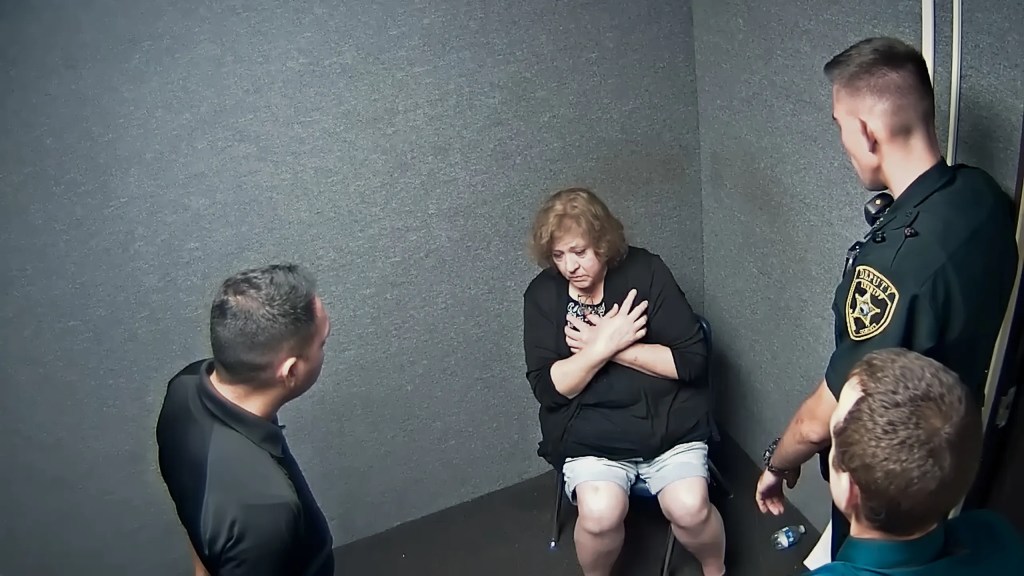
These events only take us to the midpoint of the documentary. For its second half, it shows Lorincz’s questioning, parts of the investigation, and her trial. Her defense revolves around Florida’s stand-your-ground laws. Lorincz is a white woman who shot a Black woman. To let her get away with it would reflect the long history of the American legal system allowing white people to wantonly kill Black people. And yet the law exists because denial is a key and enforced aspect of the supremacy. What can be done to prove it besides documenting it as starkly and objectively as possible? Hence the use of police footage, a tactic that certainly feels as objective as possible.
The first half of the film sticks almost entirely to bodycam footage, letting the audience watch Lorincz and her neighbors interact from a perspective nearly identical to what we’d see if we were there. It’s immersive, immediate, and engrossing, a horror show marching to its inevitable end. And then the shooting happens, and director Geeta Gandbhir makes you sit with the scarring, intimate event. Gandhir is a long-time director and editor, most notably working with Spike Lee on When the Levees Broke. That refused to look away as well, a key technique to making people see what they’ve been trained to deny. But here, the moment feels a bit too intrusive. Apart from documenting Owens’ death, the cameras also hang on her children, some of whom saw the shooting and are distraught. The cops were there and the footage exists, but I don’t think the pain they express or the unease of realizing cops are hovering is enough to justify including it. These are children, some of them very young, and I wonder what they’ll think of strangers watching this moment when they grow up. Some things are private, and this feels like an example of footage that should never be seen.
The film quickly returns to its sharp eye, expanding out to use cameras in interrogation rooms and other police footage to show the cops slow-rolling their investigation. Having seen the same things as the cops, the audience can’t deny how much leeway they give Lorincz. It takes a long time for her to be arrested, and it’s clear that, despite the cut-and-dry nature of the case, she may just get away with it. It’s a horror show once again, rubbing our faces into America’s blatant institutional racism. Some will refuse to watch the film, but anyone who does will feel just how destructive these laws are.
Release: Streaming now on Netflix
Director: Geeta Gandbhir


 Alex Wheeler Movie Ops
Leave a comment