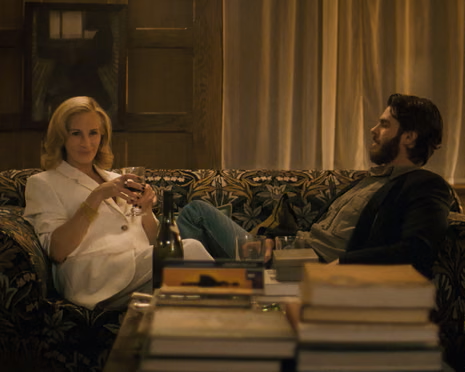
Luca Guadagnino rarely makes films about good people. They aren’t bad per se, but they navigate that hazy in-between where stretches of innocuous behavior are punctuated by uncomfortable oversteps. Okay, maybe the cannibals of Bones and All are bad. And the horny witches of Suspiria. But Zendaya in Challengers just wanted to make the boys kiss, and that’s wholesome!
Point being, no one should go to a Guadagnino film expecting straightforward morality. So it’s no surprise that After the Hunt, a psychological thriller where answers about the who, what, when, and where are withheld, is a particularly tangled web. What we know is that Julia Roberts’ Alma is in over her head. She’s a weary philosophy professor chasing tenure at Yale, competing with her friend, Andrew Garfield’s Hank, for the position. She’s generally well-liked, but people murmur behind her back and in front of her about the ‘benefits’ of being an older woman up against a younger white man. DEI hires and all that nonsense. So the last thing she needs is for her favorite student, Maggie (Ayo Edebiri), to bring her serious accusations against Hank.
When it happens, she stiffens. Maggie’s tears aren’t at the forefront of Alma’s mind. Instead, she defaults to calculations. What would her next move mean for herself? Maggie and the audience feel the coldness of that evaluation, and from then on, none of us know what to make of her. And there the film leaves you, weaving through the tenuous situation with a rather unwholesome protagonist.
Roberts plays the muddled part beautifully. She’s indecipherable, yes, but there’s just enough cracks to keep you sympathetic. Her flirtation with Hank seems to be when she’s most at ease, even after the accusation. There’s more tension with her husband, Frederik (Michael Stuhlbarg), but the prickliness feels natural for two intellectuals who have known each other for so long. And with Maggie, well, you never quite know if it’s her softness or coldness that’s a ruse.
The unknown of Alma is compelling, but the film is ill at ease when the unknown extends to the circumstances around her. While almost any story can be pulled off, a #MeToo style tale requires precision and care. The movement only brought modest gains, and the reality is that many claims like Maggie’s get ignored. She’s a young Black woman up against the might of a white man at Yale. Not even her much alluded to wealth can overcome that. The dynamics are layered and complex, and to watch it all through a calculating, older white woman is an uneasy perspective.
The character never feels false. Alma is precisely the kind of woman that can be an unexpected roadblock, a little too set in her ways to see the potential for change.
To come from that perspective critically would be one thing, but Guadagnino and writer Nora Garrett are a bit too comfortable with her position. This comes out most clearly when Maggie or anyone of her generation are around. Alma’s biting dismissal of the softness of their feelings and the firmness of their judgement doesn’t feel confined to the character. The film rolls its eyes, too, refusing to really engage with their point of view. For a film that’s trying to be slippery, to side-step, and to complicate whenever possible, to leave them so underexplored feels pointed.
Edebri does her best with the underwritten character, playing layers that very well might not have been on the page. Her Maggie always feels like she has something up her sleeve. She adores Alma, and she’s emulating her calculating nature. In reality, the film is only ostensibly about the accusation. It’s really about these two women hovering around each other with affection and disdain, the uneasiness never allowing either to settle. Everything else, like Alma’s heated time with Hank and her bizarre…friendship?… with Chloë Sevigny’s campus psychiatrist feel extraneous. It’s wonderful to watch all those excellent actors face off, but it’s far from the point.
When After the Hunt focuses on Alma, letting her placid exterior drive viewers up the wall trying to figure her out, the film crackles. That is the stuff Guadagnino excels at. Unfortunately, a whole other weighty, fraught film plays out around these moments, setting the whole thing adrift.
Release: In theaters now
Director: Luca Guadagnino
Writers: Nora Garrett
Cast: Julia Roberts, Ayo Edebiri, Andrew Garfield, Michael Stuhlbarg, Chloë Sevigny


 Alex Wheeler Movie Ops
Leave a comment