One must be careful when analyzing films like It Ends with Us to discuss the strengths and weaknesses of its application and not its genre. That’s something most people, even critics, are bad at. We are taught, by nearly every respected institution, to look down upon the hallmarks of melodramatic romances, so the genre becomes the negative, not the quality of the film within the genre.
With the relegation of romance to streaming releases, this self-evident truth would bear repeating for any such film pushing into theaters, but it’s especially critical for such an ambitious one. Because, yes, It Ends with Us is a steamy melodrama involving unbearably beautiful people falling in love. But it’s also an examination of cyclical violence and the complicated claws it sinks deep into a person.
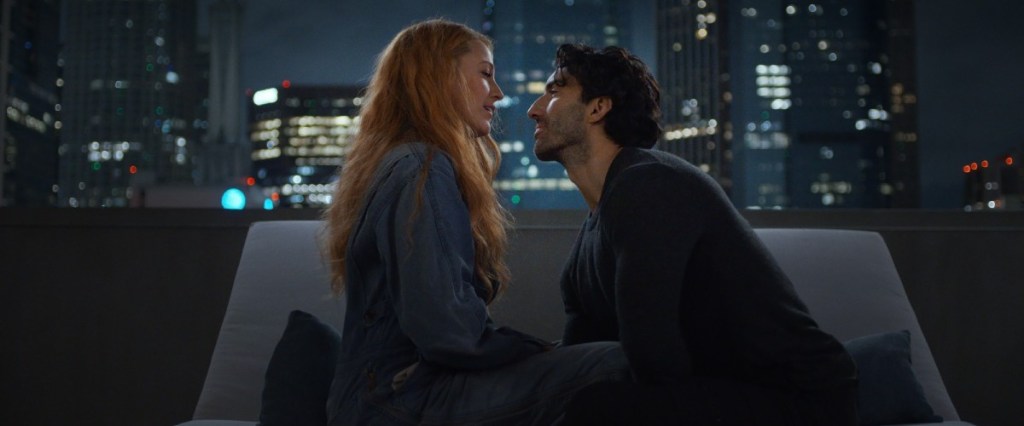
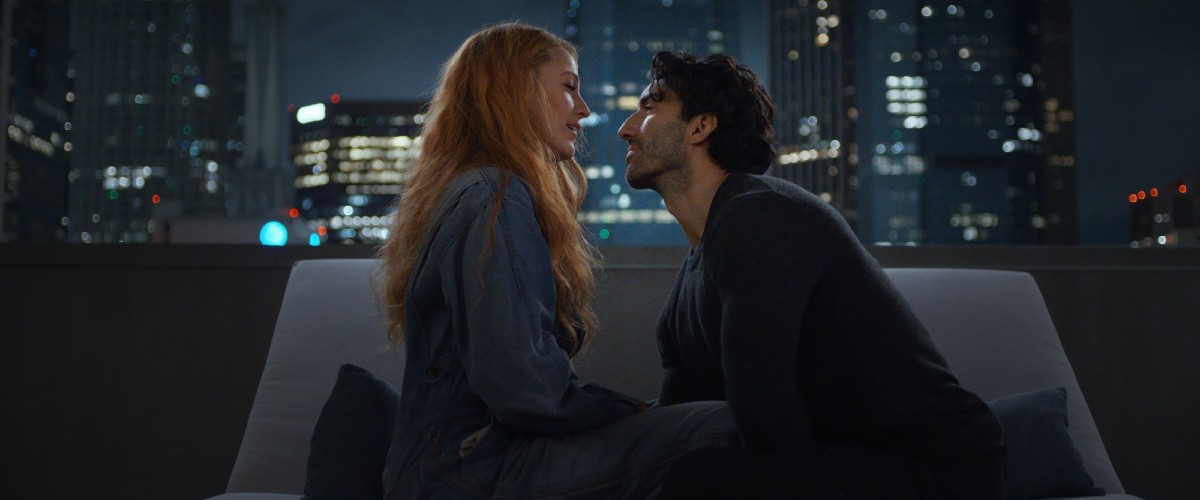
Attempting to extract herself from its grip is Blake Lively’s Lily Bloom. We first meet her at her father’s funeral, where she can’t come up with a single positive thing to say about the man. The red flags during this brief trip home are numerous, and they continue straight into her meet cute with her main paramour, Justin Baldoni’s Ryle (Baldoni also directs). Lily is on a Boston rooftop processing the funeral when Ryle storms out, kicks a chair, and then notices her. Nothing ominous there, especially when they “joke” about the chair’s strength.
On-the-nose dialogue and heavy-handed metaphors are numerous in It Ends With Us. Sometimes they grate, even after actors of the caliber of Lively attempt to smooth them (if you wish to fight me on Lively’s caliber, you better have convincing arguments against The Age of Adeline, The Shallows, and A Simple Favor). Other times, though, their directness makes for charming, powerful moments. Perhaps the entire film hinges on such a line, delivered exquisitely by Jenny Slate. It’s a moment of platonic, friendship love so deep and pure that it usurps all other caring acts in the film. Which is also a problem.
That’s because Brandon Sklenar’s Atlas is supposed to be the romantic hero. He’s the long-lost first love of Lily, their bond forming from their experience with violent men. He re-enters Lily’s life as her relationship with Ryle is taking off both romantically and physically. When Atlas first registers the violence, he reacts with his own violent anger.
It’s a complicated moment that exemplifies the uneasy balance of It Ends with Us’ ambitions. The scene is reminiscent of knights in shining armor, chivalrous and capable. But such a reaction is dangerous for Lily, both as a trigger and as something that forces her to go home with a riled-up partner. The movie attempts to hold both the former fantasy and the latter reality at once, but these pieces do not fit together. The scene does far more to make one leery of Atlas and whether he’s extricated the cyclical claws from his life, even after he apologizes for the behavior.
Not much time is given to adult Atlas to make up for this narrative stumble, either, as most of the film is spent in a much more thoughtful handling of Lily’s experience of domestic violence. This builds to two crescendos: in flashback, her father’s violence, and in the present, Ryle’s.
There’s no mystery as to her father’s nature, but the film is more cagey about Ryle’s. There’s an intriguing editing game being played, with each escalating moment of violence between Ryle and Lily being obscured just enough to leave doubt. How much the film actually shows I cannot say, because at key moments I found myself looking away. It’s a natural reaction for some, to look away from these things, and I might not have been aware of my instinct had the film not played with it. It’s easier if you don’t look at it. That’s how some of us survive hard things. And for some, this survival method traps us.
The editing implication is that Lively is trapped by this instinct, that it plays a part in keeping Ryle’s claws sunk into her. It’s a hard truth, one of several that the film puts on stark display. People need a spoonful of sugar to help such things go down, hence why pairing such bitter reality with such a frothy genre has merit. To dismiss It Ends with Us out of hand is to dismiss one of the great strengths of storytelling: the blend of art and entertainment. The fun gets people in the door. The point makes it stay in their heads. It Ends with Us offers both fun and a point, and while the blend isn’t smooth, it’s admirably ambitious.
Release: Available now in theaters
Director: Justin Baldoni
Writers: Christy Hall, Colleen Hoover
Cast: Blake Lively, Justin Baldoni, Jenny Slate, Hasan Minhaj, Brandon Sklenar


 Alex Wheeler Movie Ops
Leave a comment