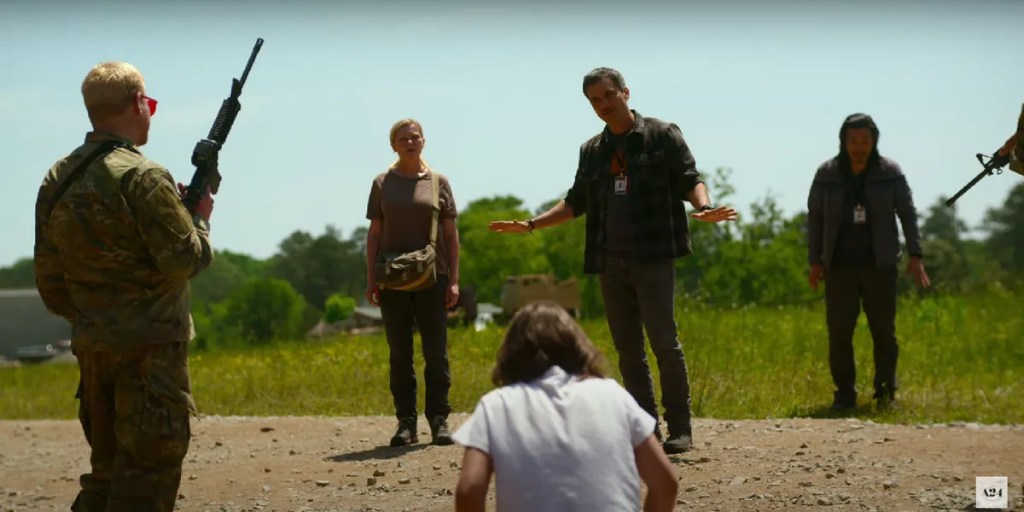
It’s impossible to make a political statement and satisfy everyone. However, avoiding a political statement doesn’t put you in a less divisive position. Not decrying a particular person or movement will be a statement to many, which writer/director Alex Garland surely knew when making Civil War. And yet, his film is almost stubbornly apolitical, taking the premise of a second American civil war, shrouding the sides in a political mishmash, and never stating why they have separated.
Of course, we can’t know Garland’s intent, but his previous films show he’s more apt to go for a broad message than a particular critique. Ex Machina dealt with the fickle humanity of our creations, Annihilation our malleability, and Men, well, its focus is stated in the title. Civil War is no different. Its focus is stated in the title, right down to the lack of country specified. It doesn’t say much about America, but it says plenty about war.
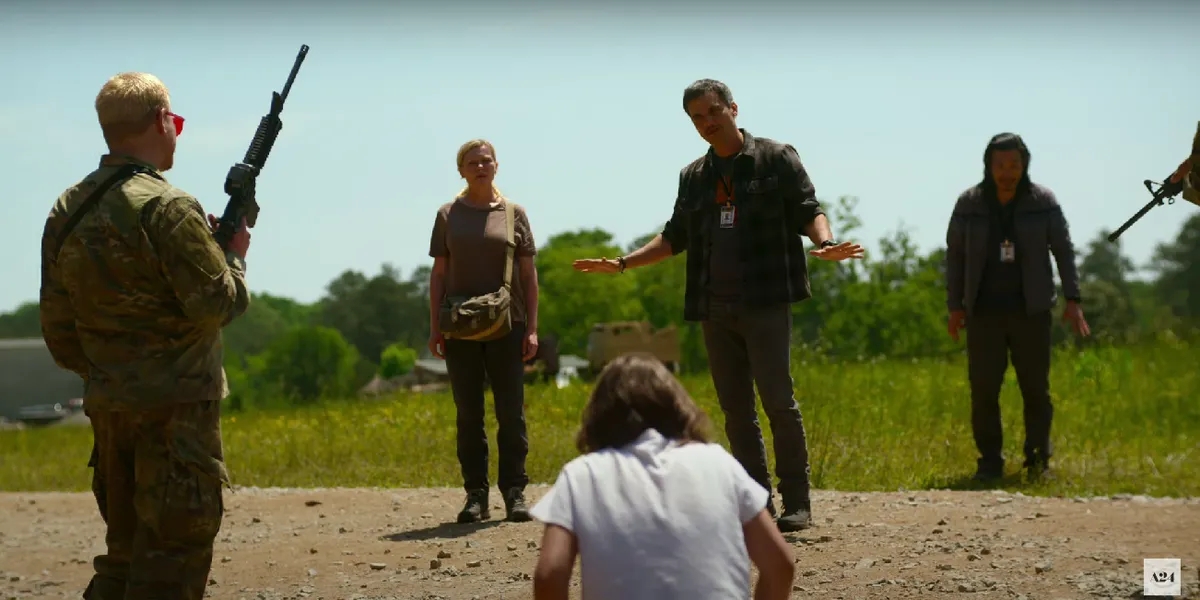
Its story is told through the journey of 4 journalists trying to find one more story before the end (?) of the fictional war. Various parts of the former United States have broken off, but the main force is about to seize the capital. The group decides to try for one last interview with the President before he’s captured. Three of them are seasoned war reporters (Kirsten Dunst’s Lee, Wagner Moura’s Joel, and Stephen McKinley Henderson’s Sammy), and they are inured to the events playing out around them. Cailee Spaeny’s Jessie is the audience’s emotional surrogate, an aspiring photojournalist looking to emulate Lee. She hasn’t seen the brutality of a cultural collapse before, and she recoils at the horrors along with us. The rest speak bluntly and do their job, with Lee’s deadened face showing just what seeing these things takes from you.
And that’s it. That’s all Civil War is about. America is ripping itself apart, and within it are a few damaged people doing what they always do. Punctuating the march are a series of immaculately crafted action scenes, each providing a glimpse at the details of destruction. Small towns fiercely protecting their resources. The military doing shady business while people are distracted. A pair of snipers presuming they are from different sides and meticulously stalking each other.
That Garland pulls off these moments is no surprise. He’s a filmmaker of unimpeachable technical prowess, and he uses these sequences to poke at anxieties and thrills. Film has a robust language for war, especially American film, which the American war machine has explicitly funded. These collaborations are intended to instill a broad sense of heroism and adventure in war, and they’ve worked. We’re primed to find these images thrilling, and Garland plays into these proclivities to get your heart rate up. It’s only after the fighting dies down that he betrays you.
Unlike those other films, Civil War is empty when the action subsides. You are left not with soldiers steadfastly navigating an important mission but flippant journalists who know there’s nothing admirable once it’s all over. When they’re in livelier moods, they chortle about what they expect their story will be. After more dire encounters, they despair over their work having no effect. War will continue no matter how potent their documentation is. So why look at all?
Dunst carries this question on her face throughout. It’s not a revelatory role (we already know she’s capable of everything from Bring It On to Melancholia), but it’s still a feat that she makes Lee feel present and unengaged at the same time. Henderson is his usual standout self, and Moura has fun as the liveliest of the bunch. But the movie really rests on Spaeny, who has been building up quite the resume in recent years. If you haven’t noticed her in Priscilla, Mare of Easttown, or Devs, you will notice her here. She nails the moment the film hinges on to answer Dunst’s question, which lingers with you long after you leave the theater.
It’s this moment that sold me on giving Garland the benefit of the doubt. I felt the emptiness others will surely complain about in Civil War. But I suspected throughout that the emptiness was the point and that Garland was going for a basic, broad observation about war. It’s not a novel observation, but what he’s saying is true. And we still haven’t learned the lesson.
Release: Available now in theaters
Director: Alex Garland
Writers: Alex Garland
Cast: Kirsten Dunst, Wagner Moura, Cailee Spaeny, Stephen McKinley Henderson, Nick Offerman


 Alex Wheeler Movie Ops
Leave a comment